
Most Google Ads accounts don’t fail because the strategy was wrong. They fail because the structure was wrong — and a bad structure makes every later decision harder. Budgets bleed into the wrong services, reports blend winners with losers, and the algorithm optimizes toward the cheapest conversions instead of the most valuable ones.
I’ve audited accounts spending five figures a month that were still running one giant campaign with 200 keywords and two ads. The fix was never a cleverer bid strategy. It was rebuilding the account so every dollar had a job, every ad group had one theme, and every report answered a real question.
1. What each level actually controls
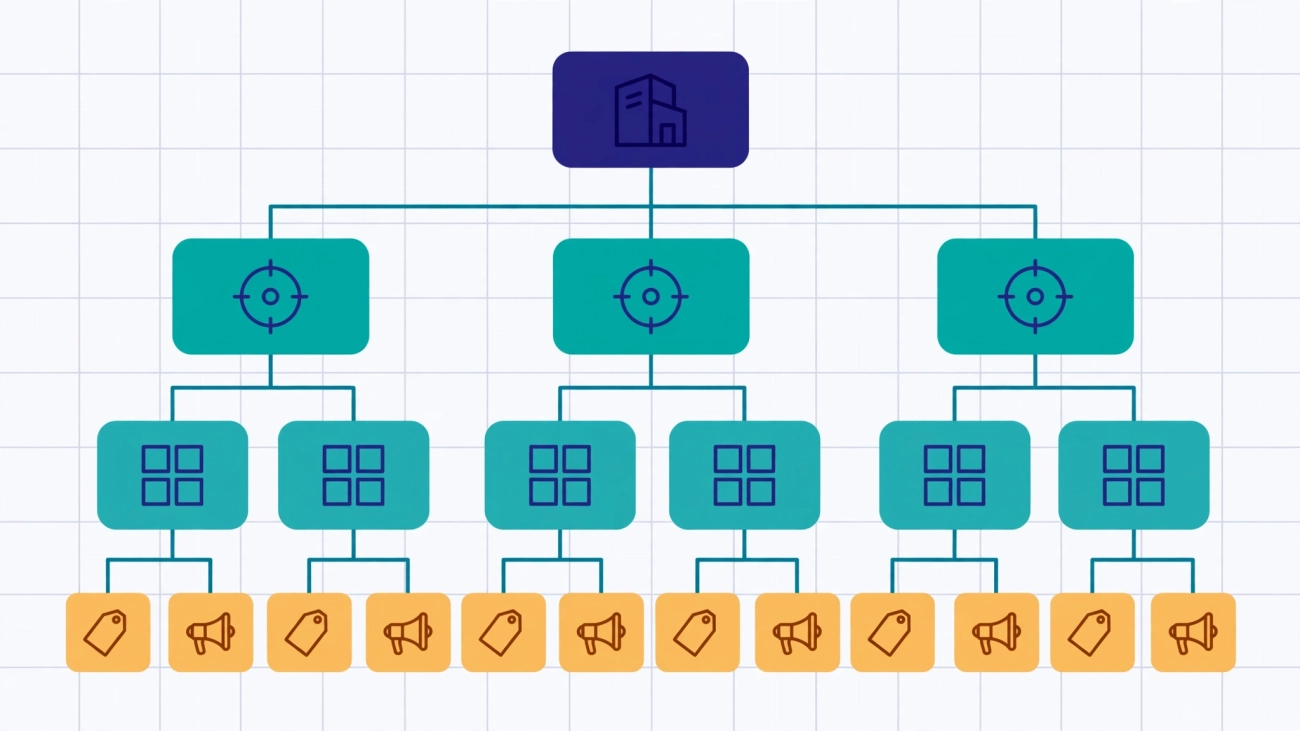
Google Ads has four levels, and the most common structural mistake is trying to control something at a level that doesn’t own it. The hierarchy is: Account > Campaign > Ad group > Ads and keywords.
- Account: billing, currency, time zone, users, and account-level conversion actions. Choose the currency and time zone carefully at setup — Google does not let you change them later.
- Campaign: the budget, the bid strategy, location and language targeting, ad schedule, networks, and the campaign type (Search, Performance Max, Shopping, Display, Video). If two things need different budgets, goals, geos, or bidding, they need different campaigns.
- Ad group: one tight theme — its keywords and the ads written for them. This is where relevance is created.
- Ads and keywords: the headlines, descriptions, and landing page the searcher sees, plus the search terms that trigger them. This is where the auction actually happens.
Google’s own account limits tell you how much room you have: up to 10,000 campaigns per account, 20,000 ad groups per campaign, and 20,000 ad group targeting items per ad group. You will never hit those ceilings in a well-run account — which is the point. Structure is not about volume. It’s about separation.
2. Start with a campaign map, not keywords
Before you open Google Ads, map the account on paper: the business’s services or product categories, the locations that matter, and the conversion that defines success for each. That map becomes your campaign list.
A campaign needs enough daily spend and enough conversions for automated bidding to learn. If the monthly budget is small, ten thin campaigns will each starve. Three focused campaigns will give you more data per campaign and clearer decisions.
3. One campaign per budget, goal, and audience
Split campaigns when the business reality demands it. These are the splits I make in almost every account:
- Brand vs. non-brand. Brand searches convert cheaply and at high rates. Mixed into a prospecting campaign, they inflate ROAS and hide the fact that new-customer acquisition is failing. A separate brand campaign keeps the numbers honest. See our Google Ads not converting fixes for how blended brand traffic masks real problems.
- Service or product line. Different services have different margins, conversion values, and competition. When they share a campaign, the highest-volume service eats the budget whether or not it’s the most profitable one.
- Geography. Split when locations differ in language, competition, margin, or performance. One national campaign averaging a great city with three terrible ones teaches you nothing.
- Campaign type. Search, Performance Max, Shopping, Display, and Video are separate campaign types with separate mechanics. Performance Max runs across Search, YouTube, Display, Discover, Gmail, and Maps from a single campaign — it needs its own budget and its own rules. See our Performance Max optimization guide for how to keep it honest.
And don’t over-split. Every split costs you conversion volume per campaign, and Smart Bidding needs volume — roughly 30 conversions in 30 days for Target CPA and about 50 for Target ROAS before performance stabilizes, per Google’s own guidance. Split only when the business reason is real.
Two settings deserve attention at campaign level. First, location targeting: Google defaults to “Presence or interest,” which includes people merely interested in your location. For most lead-gen and local advertisers, “Presence” — people in or regularly in your targeted locations — is the right choice. Second, conversion goals: set primary goals to the conversions that matter (purchase, qualified lead), and keep soft micro-conversions as secondary for observation.
4. Ad groups: one theme, one ad, one landing page
The ad group is where relevance is won or lost. My rule: every keyword in an ad group should be answerable by the same ad copy and the same landing page. If you can’t write one compelling ad that speaks directly to every keyword in the group, the group is too broad — split it.
Keep ad groups tight. As a practitioner rule of thumb, 10–20 closely themed keywords per ad group is plenty. A 200-keyword ad group forces one ad to serve 200 different intents, and the result is generic copy, weak relevance, and a Quality Score that drags your CPCs up. Google reports Quality Score through three components — Expected CTR, Ad relevance, and Landing page experience — each rated Above average, Average, or Below average. The fastest fix for a low score is usually structural: a tighter theme, not a bid change.
One landing page per ad group is the standard. The ad promises something, the page delivers exactly that thing. A great ad pointed at a generic homepage wastes the click.
5. Keywords: themed, matched, and guarded
Each ad group should hold one match-type strategy per theme. The match types still matter, but their roles have changed:
- Broad match is the workhorse for mature Smart Bidding campaigns. Google’s own guidance is that broad match pairs particularly well with Smart Bidding strategies — Maximize conversions, Maximize conversion value, Target CPA, and Target ROAS — because the algorithm learns faster from the wider signal.
- Phrase match is the control layer. It keeps you on queries that contain your phrase in the right intent, and it’s where I start new campaigns or tight-budget accounts.
- Exact match is the scalpel: your highest-intent, highest-value terms, kept in their own tightly themed groups where you want maximum message control.
Start tighter (phrase and exact), loosen gradually (broad) as conversion volume and tracking quality justify it — and read the search terms report weekly. Broad match will find queries you never imagined; the search terms report is where you decide which discoveries become keywords, and which become negatives. Guard them with negatives at three levels: ad group negatives for terms wrong for one theme, campaign negatives for terms wrong for the whole campaign, and shared negative keyword lists for the evergreen exclusions every campaign needs.
6. Ads: responsive search ads done properly
Responsive search ads are the only Search ad format you can build today — Google retired expanded text ads in June 2022. Each RSA takes up to 15 headlines (30 characters each) and up to 4 descriptions (90 characters each), and Google assembles up to 3 headlines and 2 descriptions per impression.
That only works if you feed it real variety. Write all 15 headlines as genuinely different angles — the keyword theme, the value prop, the outcome, social proof, a differentiator, the offer, and the call to action. Each headline must stand alone: Google can serve any three together, so never write headlines that only make sense in sequence.
Run two to three RSAs per ad group (Google allows up to three enabled RSAs per ad group) and read asset-level performance monthly: replace assets rated “Low,” keep the “Best” ones. Pin sparingly — pinning locks a headline into a fixed position and shrinks the combinations Google can test. Pin only what must always show. Ad Strength is a diagnostic, not a ranking factor — “Poor” usually means too few or too-similar assets.
7. Naming conventions and shared libraries
Structure is also a reporting discipline. A consistent naming convention turns a chaotic account into one you can read at a glance — and it makes bulk edits, filters, and automation rules possible. The template I use: Campaign: [Type] – [Service/Product] – [Geo] – [Funnel]; Ad group: [Theme] – [Match focus].
Use the shared library instead of rebuilding things campaign by campaign: shared negative keyword lists, shared budgets, audience segments, and assets. Keep conversion actions clean at the account level: one accurate purchase or lead action, deduplicated, with correct values. If your tracking is off, no structure will save you — run our GA4 conversion tracking audit checklist before you scale spend.
8. When to restructure — and when to leave it alone
Not every messy account needs a rebuild. Restructure when the structure itself is the problem: budgets flowing to the wrong service, brand traffic inflating prospecting ROAS, ad groups so broad that no ad can speak to them, or reports that can’t answer which service is actually profitable.
And never restructure during a learning window. Every major change — a bid strategy switch, a big budget shift, a target change — restarts the learning period, roughly 1–2 weeks of instability before performance settles. Batch your structural changes, then leave the account alone long enough to read the results.
When you do rebuild, do it in stages: fix conversion tracking first, then campaign splits, then ad groups and ads. Build the new structure, let it gather data, then pause the old one.
The bottom line
Good structure is boring, and that’s the point. One campaign per budget, goal, and audience. One theme per ad group. One landing page per ad group. Tight keywords, guarded by negatives at three levels. Responsive ads with real variety, pinned sparingly. A naming convention that lets you read the account like a report.
If your account feels like a black box, the structure is the first place I look. It’s the first thing we fix for every Google Ads management client — before we touch a single bid.
Frequently Asked Questions
How many campaigns should a Google Ads account have?
As many as the business needs — one per budget, goal, and audience. A small account often runs well on 3–5 campaigns (brand, core prospecting, remarketing, plus Performance Max or Shopping if relevant). Every split costs conversion volume per campaign, so don’t create campaigns just for cleaner-looking reports.
How many keywords should be in one ad group?
As a practitioner rule of thumb, 10–20 tightly themed keywords per ad group. Google allows up to 20,000 targeting items per ad group, but that ceiling is not a target. If one ad can’t speak directly to every keyword in the group, split the group.
Should brand and non-brand keywords be in the same campaign?
No. Brand searches convert cheaply, so mixing them into a prospecting campaign inflates ROAS and hides whether new-customer acquisition is working. Keep brand in its own campaign, and judge prospecting on non-brand performance.
How many ads should each ad group have?
Run two to three responsive search ads per ad group — Google allows up to three enabled RSAs per ad group. Each RSA should carry up to 15 genuinely different headlines and 4 descriptions. Read asset-level performance monthly and replace “Low” assets.
When should I restructure my Google Ads account?
When the structure itself is causing the problem: budgets flowing to the wrong service, brand traffic inflating prospecting ROAS, ad groups too broad for any ad to speak to, or reports that can’t tell you which service is profitable. Don’t restructure during a learning window or for tidiness alone.
Does account structure affect Quality Score?
Indirectly, but powerfully. Quality Score is built from Expected CTR, Ad relevance, and Landing page experience. A tight structure — one theme, one ad, one landing page per ad group — lifts all three. Structure doesn’t set your Quality Score; it creates the conditions for a good one.
Israr Ads is a performance marketing agency managing Google & Meta ad spend for e-commerce and lead-gen brands. If your Google Ads account feels like a black box, get a free audit and we’ll tell you exactly what’s wrong — no fluff.